
What Is Ringlock Scaffolding
Ringlock scaffolding is a modular, multi-directional steel scaffolding system that connects its standards, ledgers and braces through a ring-shaped node called a rosette. Because every rosette has eight openings arranged around a full 360°, members can lock in at almost any angle — not only at right angles — which is why ringlock has become the default choice for high-rise façades, bridges, industrial plants and other complex geometry where tube-and-coupler scaffolding is too slow and too fiddly.
This guide explains what ringlock scaffolding is, how the rosette connection works, the main components and sizes, how a bay is assembled, what the system can carry, where it is used, and the safety rules that keep crews safe at height.
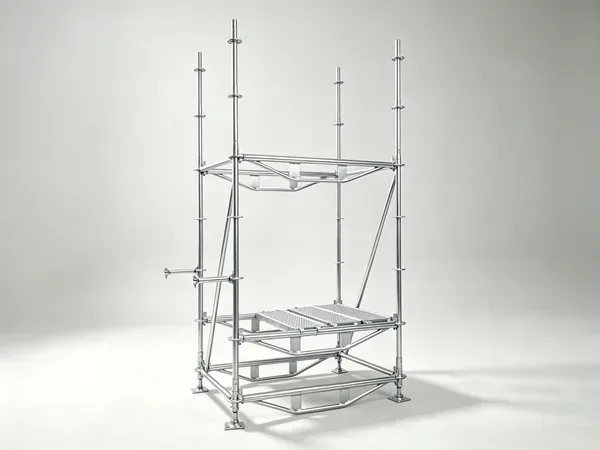
What is ringlock scaffolding?
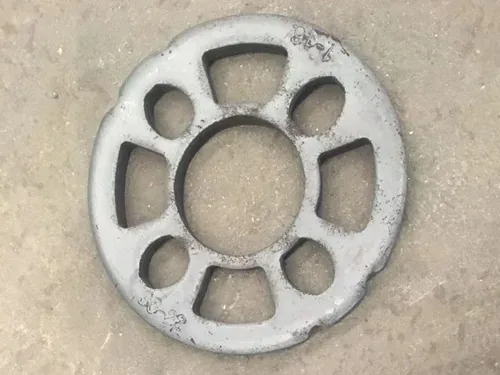
Ringlock scaffolding — also written ring lock or ring-lock, and known generically as a modular or multi-directional system — is built from steel tube with a forged or cast rosette welded to each vertical standard. The rosette is a flat disc with eight punched holes and a central locating slot. Horizontal ledgers, diagonal braces and truss members drop their wedge heads onto the rosette and are secured with a single hammer blow on a captive wedge. There are no bolts, no couplers and no loose parts to drop.
The result is a rigid, three-dimensional structure that goes up and comes down quickly. A trained crew erects and dismantles ringlock roughly 30% faster than an equivalent cuplock scaffold, and because the connection is symmetrical it is almost impossible to seat a node incorrectly — a property engineers call fault tolerance.
How the rosette connection works
Every rosette provides up to eight connection points plus a vertical spigot for the standard above, so a single node can carry ledgers on four faces, diagonal braces between faces, and a truss or cantilever bracket — all at the same level and all at different angles. The wedge is captive, so it cannot be dropped; it is hammered down to lock and knocked up to release.
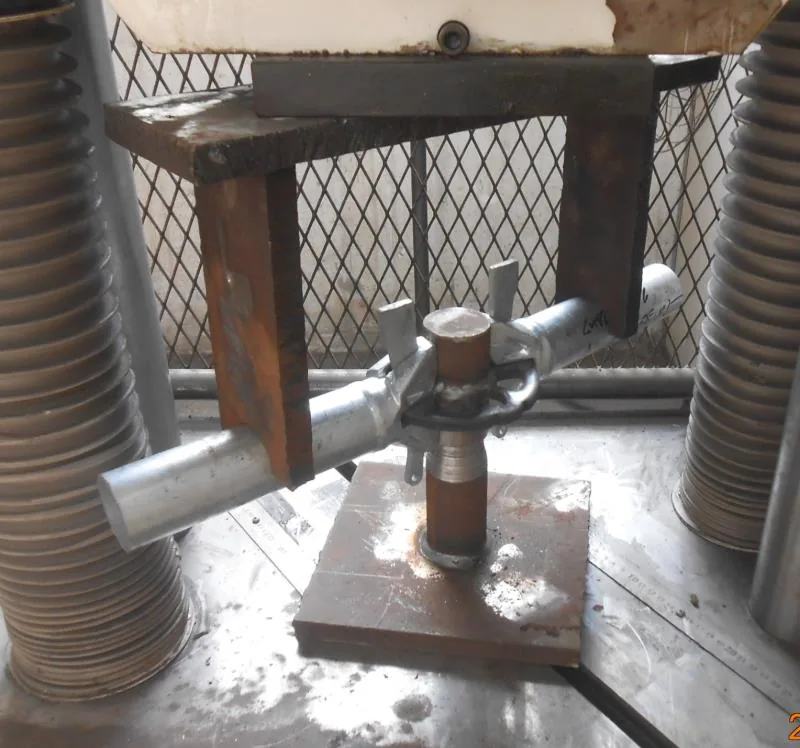
Each certified connection in a ringlock system is rated to carry 11.12 kN (2,500 lbs), and the standards — typically Ø48.3 × 3.2 mm tube in Q345 or S355 steel — carry the combined leg load down to the base. Because the load path through the rosette is short and direct, ringlock systems reach high working-platform load classes and are widely used for shoring as well as access.
Main components of a ringlock system
A ringlock bay is assembled from a small, standardised kit. The table below lists the components you will find on most systems, including the deep truss variants used for heavy loads.
| Component | What it does |
|---|---|
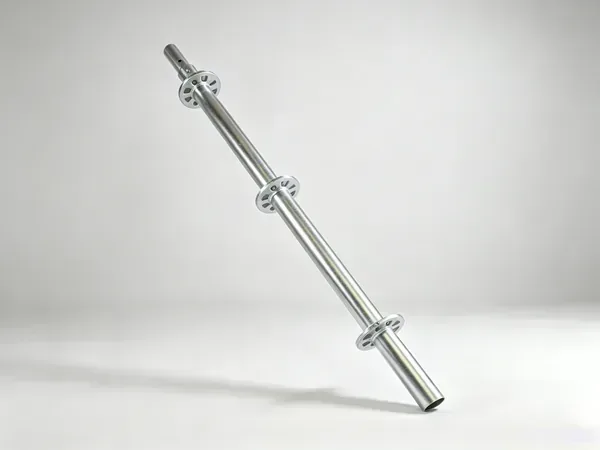
| Standard (vertical) | The upright tube, with rosettes welded at 500 mm (19½") intervals; sets the bay height. |
| Ledger (horizontal) | Connects standards face-to-face; wedge heads lock into the rosette and carry the planks. |
| Diagonal brace | Triangulates the bay to resist sway and keep the structure plumb. |
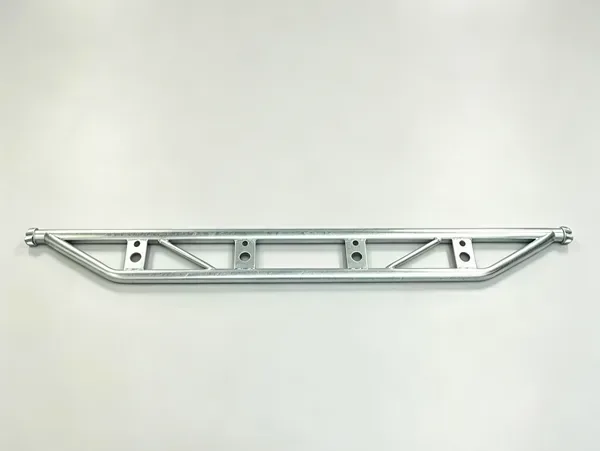
| Truss / double ledger | A deep, two-chord ledger used where heavy loads or long spans must be bridged. |
| Base collar & base jack | Spreads the leg load and levels the tower on uneven ground. |
| Plank / board | Steel or aluminium decking with an anti-slip surface that forms the working platform. |
| Guardrail & toe board | Edge protection at every platform; toe boards stop tools and material falling. |
| Ladder & stair tower | Safe internal or external access between levels. |
| Lattice girder | Fabricated beam for bridging openings, suspended scaffolds and load transfer. |
How to assemble ringlock scaffolding
Ringlock is forgiving to build, but sequence still matters. A typical bay goes up in this order:
- Prepare the ground. Set sole boards or base plates on firm, level ground and fit adjustable base jacks to take up any fall.
- Stand the first standards. Push each standard into its base collar and check the tower is plumb before locking anything in.
- Add the ledgers. Drop the wedge heads onto the rosettes at the required lift height and hammer the wedges home to create the first working platform.
- Brace the bay. Fit diagonal braces on alternate bays to stop the structure swaying, then re-check level and plumb.
- Deck it out. Lay scaffold planks across the ledgers so the platform fully covers the work area, with no gap a tool can fall through.
- Protect the edges. Fit guardrails and toe boards to every platform and install a ladder or stair for access.
- Tie in and inspect. Tie the scaffold to the structure at the engineer’s spacing, then complete a documented inspection and attach a status tag before anyone works off it.
How much can ringlock scaffolding carry?
Capacity starts at the node: every certified connection is rated to 11.12 kN (2,500 lbs), and the standards are made from high-strength steel tube that is hot-dip galvanized to EN ISO 1461 for corrosion resistance. Working-platform load classes — light, medium and heavy duty — are set by the plank width, the number of standards in each bay and the bracing, so a ringlock scaffold can be configured from light inspection work through to heavy masonry and shoring. For genuinely heavy loads, engineers specify the truss ledger or a lattice girder rather than a single standard ledger.
Where ringlock scaffolding is used
Because it is strong, adaptable and fast, ringlock is the system of choice across a wide range of work:
- High-rise façade access — the eight-way rosette follows curves, returns and stepped elevations.
- Bridges and viaducts — combined with lattice girders for under-bridge and pier access.
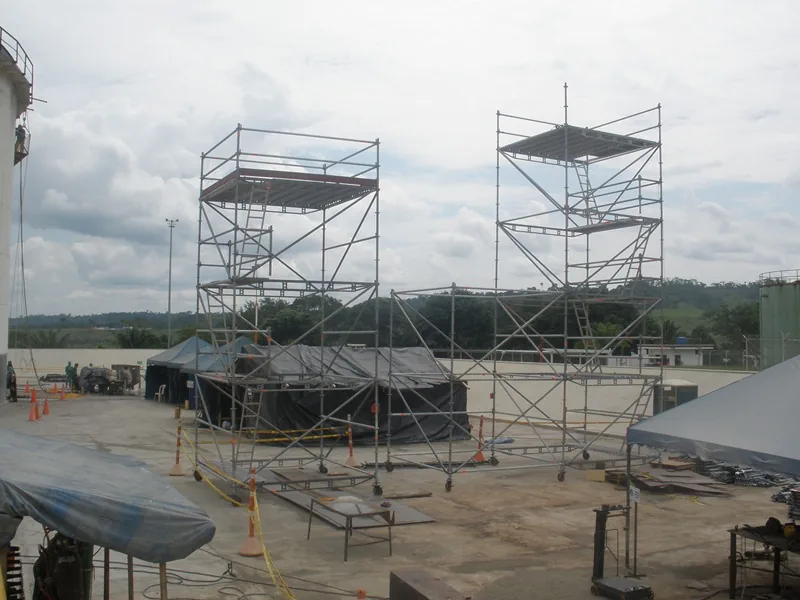
- Industrial plants and refineries — oil & gas, power stations and boiler work, where heavy duty and corrosion resistance matter.
- Shoring and formwork support — the same components double as a high-capacity falsework system.
- Shipyards and offshore — staging on hulls, tanks and in confined spaces.
- Events, stadiums and maintenance — rapid build and strip for temporary access.
For lighter industrial or shoring work a cuplock system is often the more economical choice; ringlock wins when the geometry is complex or the loads and heights are high. See also why contractors choose cuplock for heavy loads.
Ringlock vs other scaffolding systems
| System | Connection | Best for |
|---|---|---|
| Ringlock | Rosette + hammer wedge, 8-way | Complex, multi-directional and heavy-duty access & shoring |
| Cuplock | Cup-and-blade, 4-way | Fast, economical access and formwork shoring |
| Frame | Prefabricated frames + cross braces | Straight-run, simple façades and masonry |
| Tube & coupler | Bolted right-angle / swivel couplers | One-off shapes where nothing standard fits |
Ringlock scaffolding safety guidelines
Good hardware does not replace good practice. Keep to these rules:
- Train and certify everyone who erects, alters or dismantles the scaffold, and brief the users.
- Inspect the scaffold before first use, after any alteration and after severe weather — record it and attach a visible status tag.
- Found it properly. Level, firm ground, sole boards and base jacks; never pack a standard on loose blocks.
- Tie it in at the engineer’s spacing so the scaffold cannot overturn.
- Protect every edge with guardrails and toe boards, and close every platform with planks.
- Respect the load limits. Never exceed the rated platform load and keep materials evenly spread.
- Do not mix systems component by component unless the parts are designed to be compatible.
- Control the area with exclusion zones and signage while the scaffold goes up or comes down.
For a checklist you can run before every shift, see 14 common scaffolding safety hazards.
Frequently asked questions
Is ringlock the same as Layher Allround? They are different brands of the same modular concept. European ringlock is dimensioned to be compatible with Allround, while North American ringlock uses imperial bay sizes.
How much weight can one ringlock connection hold? Each certified rosette connection is rated to 11.12 kN (2,500 lbs); the tower’s overall capacity depends on the standards, the bay size and the bracing.
Do I need special tools? No — a standard scaffold hammer is all that is required to lock and release the wedges.
Getting the right ringlock scaffolding
ACE SCAFFOLD manufactures ringlock scaffolding in Q345/S355 steel, hot-dip galvanized to EN ISO 1461 and tested to EN 12810, and supplies it as a complete system — standards, ledgers, braces, truss ledgers, lattice girders, planks, stair towers and accessories — with OEM/ODM support and FOB Shanghai delivery. Explore the ringlock scaffolding range, read more on the ACE SCAFFOLD blog, or contact our team for project-specific advice. To see how the system performs on site, read ringlock scaffolding: the modular system built for speed.
More from ACE SCAFFOLD Blog
- What is ICF means
- ICF bracing setup
- Bracing for ICF House
- Advantages of ICF House
- Ringlock Scaffolding: The Modular System Built for Speed
- Why Contractors Choose Cuplock Scaffolding for Heavy Loads
- Frame Scaffolding: The Reliable Workhorse of the Job Site
- Steel Props: Adjustable Shoring Made Simple
- Scaffold Planks: Steel vs Aluminum Walk Boards
- Aluminum Mobile Scaffold Towers for Fast Indoor Access
- 14 Common Scaffolding Safety Hazards and How to Prevent Them
- Temporary Roofing System User Guide
- What is the packing of scaffolding