
What Are the Key Differences Between Ringlock and Cuplock Scaffolding?
Ringlock and cuplock scaffolding are the two modular steel systems that have replaced tube-and-coupler scaffolding on most modern sites. They look alike from the ground — both are built from Ø48.3 mm tube, neither needs loose bolts, and both go up far faster than a coupler scaffold — but the joint welded to every vertical standard is completely different, and that one difference decides everything else: how many members can meet at a single node, how the structure behaves under wind and lateral load, how fast it erects, how long the parts last, and which projects each system is actually right for.
This guide compares ringlock and cuplock scaffolding point by point — connection mechanism, node capacity, steel and tube sizes, load behaviour, assembly speed, bracing, durability, storage, training and cost — and finishes with a straight answer on how to choose between them.
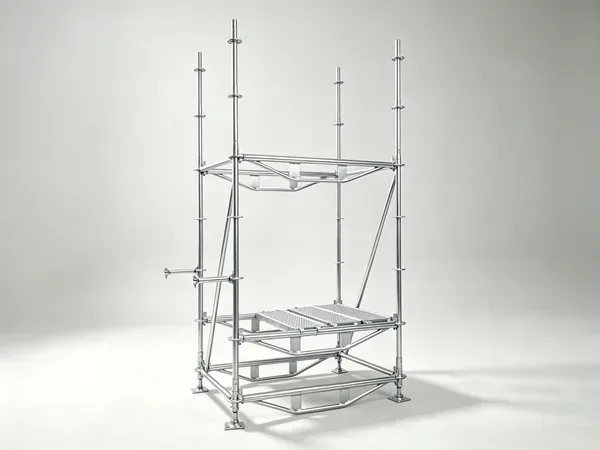
The short answer
If you only read one paragraph: cuplock locks four members per node at right angles through a cup-and-blade joint; ringlock locks eight members per node at 45°, 90° and 135° through a rosette-and-wedge joint. Everything else — speed, bracing, durability, cost — follows from that single design decision.
| Aspect | Cuplock | Ringlock |
|---|---|---|
| Joint | Fixed bottom cup plus sliding top cup; ledger blade ends sit in the cup | Welded rosette disc plus captive wedge through the slot |
| Members per node | 4, right angles only | 8, at 45°, 90° and 135° |
| Node spacing | 500 mm on the standard | 500 mm on the standard |
| Locking action | Drop the top cup over the blades and rotate it down | One hammer strike drives the wedge home |
| Strongest at | Vertical load and rectangular, repeating layouts | Multi-directional load and complex geometry |
| Diagonal bracing | Often added with separate couplers and tube | Braces lock into the rosette itself |
| Wear point | Cup faces, which wear with repeated friction | Wedge and rosette, which hold tightness longer |
| Storage | Two cups per standard, so bulkier to stack | Rosette only, so more compact |
| Cost | Lower initial investment | Higher initial investment, stronger long-term ROI |
How the two joints actually work
On a cuplock system, every vertical standard carries two cups at each 500 mm node: a fixed cup welded at the bottom and a loose cup that slides above it. A horizontal ledger ends in a flat forged blade. You drop the blade into the bottom cup, then slide the top cup down over it and rotate it to lock. The cup presses all the blades in that node together, so the joint relies on friction and compression between cup faces.
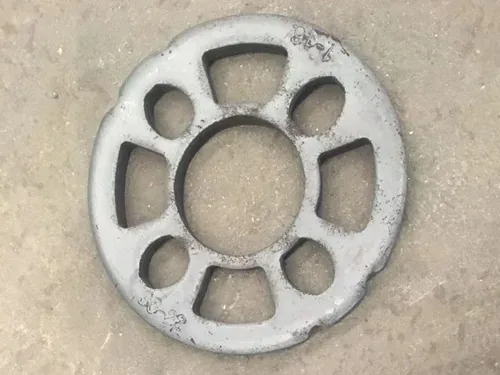
On a ringlock system, every standard carries a flat steel disc — the rosette — welded at the same 500 mm intervals. The rosette has eight punched openings: four narrow slots for horizontals and four wider slots for diagonals. A ledger or brace ends in a wedge head that drops into the slot, and a captive wedge hammered down locks it. There is no friction joint to slacken: the wedge physically fills the slot.
Four directions versus eight: why node count matters
This is the difference engineers notice first. A cuplock node accepts four ledgers, all at right angles. Build a straight, rectangular façade or a square birdcage and that is perfectly adequate — the geometry only ever needs 90°. But bring a curved elevation, a splayed tower, a ramp, a chimney or a bridge soffit and the right-angle limit bites. The fix on site is to bolt on extra couplers and short tube to create the angles, which means more components, more weight, more time and more joints that a fitter can get wrong.
A ringlock node accepts eight members — four ledgers and four diagonals — at 45°, 90° and 135°. Diagonal bracing becomes part of the system rather than an add-on, and the brace connects exactly where the engineer designed it to. That is why ringlock dominates curved façades, stadium bowls, tunnels, power plants and shoring where the frame is not a simple box.
Assembly speed and labour
The honest answer here is that it depends on the shape you are building, and both systems have a case:
- Ringlock is faster where the geometry is complex. Because braces and ledgers lock into the rosette itself, there is no hunting for couplers and no second operation to add bracing — published comparisons put the labour saving on irregular structures at 30% or more.
- Cuplock is very competitive on straight, repetitive layouts. Locking a cup is a well-practised, low-precision action, and on a uniform rectangular façade crews get into a rhythm. Some suppliers report cuplock edging ahead by 15–20% on simple linear runs.
The difference that holds regardless of shape is how many hands you need. Because a cup presses down on several blades at once, a cuplock node is easier to disturb before it is locked, so crews often work in pairs or more to hold horizontals in place. Ringlock's independent wedge locks let one person place and lock a member without holding anything else.
Steel, tube sizes and strength-to-weight
Both systems are built from high-strength steel tube. ACE SCAFFOLD supplies ringlock and cuplock components in Q345/S355 steel tube, Ø48.3 × 3.2 mm, hot-dip galvanized to EN ISO 1461 and manufactured under EN 12810 and ISO 9001.
The structural difference is not the steel grade but where the mass sits. A cuplock standard has to carry two cups at every node, which adds weight and bulk to the most numerous component in the system. A ringlock standard carries a single thin disc. So for the same tube and similar strength, ringlock components are lighter and stack tighter — and because every member is wedged rather than pressed, the joint does not need excess mass to hold. Lighter components mean less fatigue when a crew is passing them up all day, and fewer crane or hoist lifts on tower work.
Load capacity and bracing behaviour
Both systems are strong, and both are certified for the same working-platform load classes when they are specified and erected correctly. The real difference is the direction the load comes from:
- Cuplock is excellent in pure vertical compression. The cup joint is very good at carrying a direct downward load, which is exactly what a shoring tower or slab formwork support does all day. This is why cuplock remains a first choice for heavy support work and dense birdcage scaffolds. Its weakness is lateral force: on a tall scaffold exposed to wind, a cuplock frame normally needs additional independent bracing rather than relying on the cup joint alone.
- Ringlock is stronger in shear and lateral load. Eight connections distribute horizontal, diagonal and vertical forces through the node, and because diagonals lock in without extra fittings, the unsupported length of each standard is easier to keep short. That matters on tall towers, exposed coastal sites and anything that catches wind.
On a rated basis, each certified connection in an ACE SCAFFOLD ringlock system carries 11.12 kN (2,500 lbs), and the tower's overall capacity is governed by the standard, the bay size and the bracing pattern. Published figures for whole standards vary widely by manufacturer and configuration — commonly quoted ranges are around 30–40 kN per standard for cuplock and 40–60 kN for ringlock — so always design from the certified data sheet for the system you actually buy, not from a generic comparison.
Adapting to uneven ground and changing heights
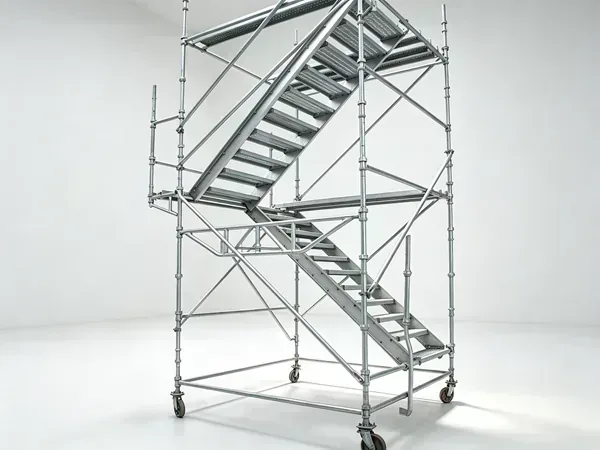
Sites are never flat, and this is where the systems diverge again. Ringlock has a wider family of height-adjustment parts built into the same connection language: base collars, adjustable base jacks, U-head jacks and sub-vertical extensions that let a tower step to a slope or a soffit without splicing in odd tube lengths. Cuplock can be levelled with its own base jacks, but where the height step is large, crews more often fall back on timber packing or extra tube — workable, but slower and harder to inspect.
Safety and mis-assembly
Both systems are safe when erected to the manufacturer's instructions, and both are widely accepted under EN 12810/12811, OSHA and AS/NZS 1576. Two practical differences matter on site:
- Captive wedges cannot be dropped. On ringlock the wedge stays with the head, so there is nothing to lose and nothing to leave loose at height. A correctly struck wedge either locks the member or visibly does not.
- The rosette is self-checking. A wedge head that is not square or not the right size simply will not enter the slot. That makes a wrong connection obvious rather than subtle — a useful property when crews rotate or when a site is under time pressure.
With cuplock the discipline required is making sure the top cup is fully rotated and seated. A cup left part-turned can look closed from the platform. That is a training and inspection issue rather than a design fault, but it is the reason cuplock procedures put such emphasis on hammer-checking every cup before a lift is loaded.
Durability, wear and service life
Both systems last for years when hot-dip galvanized, which is how ACE SCAFFOLD supplies them. The difference is where they wear. A cuplock joint locks by friction between the cup faces and the blade, so repeated assembly abrades those faces, and a worn cup grips less positively over time. Ringlock locks by a wedge filling a slot, a much smaller contact area carrying a direct shear load, so tolerance holds up better across many cycles. For a rental fleet that turns equipment over constantly, that shows up as a longer service life and fewer components pulled from service — the single most-cited reason large hire companies have shifted their buying toward ringlock.
Storage, transport and site logistics
Standards are the most numerous component on any job, so their shape drives logistics. A cuplock standard carries a cup at every node, and those cups protrude, so standards do not stack flat and take more racking space and more truck volume. A ringlock standard carries a flush disc, so bundles sit tighter and you move more metres of scaffold per load. Over a large project this is a real cost line: fewer trucks, fewer stillages, less yard space.
Training and skill dependency
Ringlock is generally quicker to teach. The rosette is intuitive, the wedge is a single action, and many manufacturers colour-code components. A new starter can be productive on a ringlock tower in a short induction. Cuplock needs a little more instruction on seating and rotating the top cup correctly, and the four-direction limit means crews must know when to add couplers rather than improvise. In markets where cuplock has been the norm for decades — the UK and much of the Commonwealth, India — that knowledge is already on site and cuplock is often the pragmatic choice.
Cost and long-term return
Cuplock usually wins on purchase and rental price. Its joint is simpler to manufacture, and for a contractor running repetitive rectangular work the lower capital outlay is hard to argue with. Ringlock costs more per tonne up front — commonly quoted at 15–25% above cuplock — and earns that back through faster erection on complex work, less added bracing, lighter transport and longer component life. For a fleet that has to serve many different project types, ringlock also tends to achieve higher utilisation because one kit covers more geometries. Because the bracing locks into the rosette itself, ringlock also needs fewer custom couplers and adaptors — less to buy, less to store and less to replace over the life of a fleet covering industrial, infrastructure and renovation work.
The practical test is not price per tonne. It is total installed cost: erection labour, bracing components, transport, inspection time, replacement rate and how many projects the kit can be reused on.
Which system for which job
Choose cuplock when the work is rectangular and repetitive, vertical load dominates, and budget is tight: façade access on regular buildings, slab and beam formwork support, shoring towers, dense birdcage scaffolds, and markets where cuplock crews and spares are already everywhere.
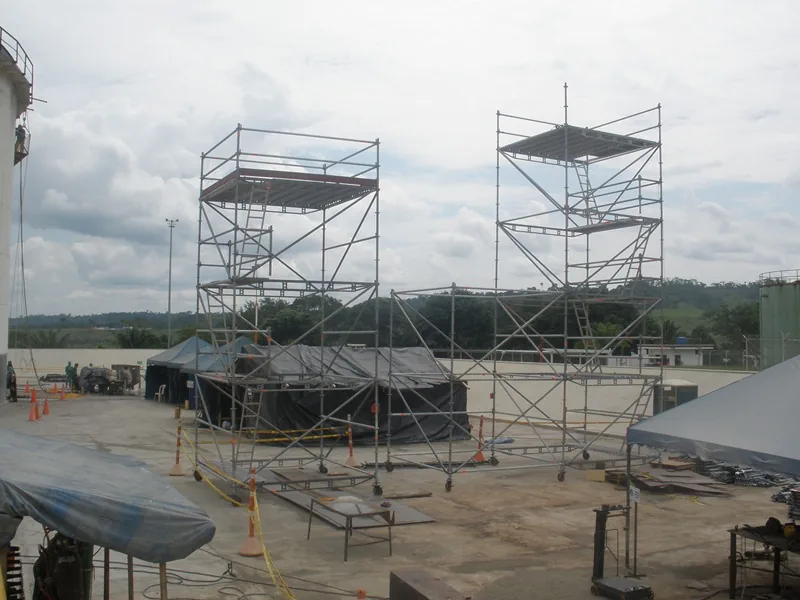
Choose ringlock when geometry or load direction is complex, or when you need one system to cover many project types: curved and splayed façades, bridges and underpasses, tunnels, stadiums and grandstands, power plants and refineries, offshore and coastal work, and any tall structure exposed to wind.
Many contractors run both, and that is a sound strategy rather than a compromise: cuplock for the straight repetitive volume work, ringlock for everything with an angle in it. If you are comparing ringlock against other options as well, our guide to frame scaffolding covers the third system commonly considered for access work.
Whichever way you are leaning, four questions usually settle it: how complex is the shape — straight repetitive runs favour cuplock, anything with an angle in it favours ringlock; which way does the load come from — pure vertical compression favours cuplock, lateral and multi-directional load favours ringlock; how exposed is the site — wind and coastal exposure favour the eight-way rosette; and what does the kit have to do over its working life — one system that covers many project types usually beats the lowest price per tonne.
In practice that maps onto recognisable jobs. Cuplock suits repetitive residential and commercial façade access, slab and beam formwork, standard bridge formwork support, shoring towers and low-rise uniform industrial workshops. Ringlock suits curved façades, irregular roof restoration where a temporary roofing system goes up first, tunnel support, stadium grandstands, high-rise industrial plants, offshore maintenance scaffolds and public event stages.
Frequently asked questions
Is ringlock stronger than cuplock? Not in every direction. Cuplock is excellent in vertical compression, which is what shoring needs. Ringlock is stronger in shear and multi-directional load because eight connections spread the force and diagonals lock into the node itself. For heavy shoring towers both work well; for complex or wind-exposed geometry ringlock has the advantage.
Can I mix ringlock and cuplock on one job? The two systems do not interconnect — the joints are incompatible — but they can be used side by side as separate scaffolds or shoring towers on the same site. Just keep components segregated so a cup standard never ends up in a rosette frame.
Which is faster to erect? Ringlock on complex geometry, where it avoids hunting for couplers and can cut erection labour by 30% or more. Cuplock on straight repetitive runs, where the cup action is quick and crews are already fluent. If your work is one uniform rectangular façade, cuplock is often the faster and cheaper answer.
Do both systems meet the same standards? Yes. Correctly manufactured, both can comply with EN 12810/12811, OSHA and AS/NZS 1576. What differs is how easily each holds compliance over years of use — ringlock's wedge-and-rosette joint wears less than a friction cup joint.
Why do rental companies prefer ringlock? Utilisation and service life. One ringlock kit covers more geometries, so it is hired out more often, and the wedge joint keeps its tolerance through far more assembly cycles, so fewer components are scrapped.
Getting the right system for your project
ACE SCAFFOLD manufactures ringlock and cuplock scaffolding and the full range of accessories for both — standards, ledgers, braces, planks, base jacks, brackets and shoring heads. Because we make both, we have no reason to push one: send us the geometry, the heights and the loads and we will tell you which system your project is actually cheaper and safer with, then quote FOB Shanghai with OEM and ODM options.
For a deeper look at the system built around the rosette joint, read what is ringlock scaffolding. If your work is heavy vertical shoring, see why contractors choose cuplock for heavy loads, and for the modular system's speed story see ringlock scaffolding: the modular system built for speed.
More from ACE SCAFFOLD Blog
- What is ICF means
- ICF bracing setup
- Bracing for ICF House
- Advantages of ICF House
- Ringlock Scaffolding: The Modular System Built for Speed
- Why Contractors Choose Cuplock Scaffolding for Heavy Loads
- Frame Scaffolding: The Reliable Workhorse of the Job Site
- Steel Props: Adjustable Shoring Made Simple
- Scaffold Planks: Steel vs Aluminum Walk Boards
- Aluminum Mobile Scaffold Towers for Fast Indoor Access
- 14 Common Scaffolding Safety Hazards and How to Prevent Them
- Temporary Roofing System User Guide
- What is the packing of scaffolding
- What Is Ringlock Scaffolding