
Ringlock Scaffolding Diagonal Brace
Engineered to international standards for safety, speed and durability on every job site.
Overview
The Ringlock Scaffolding Diagonal Brace — often called a ringlock bay brace, diagonal or swivel brace — is the diagonal strut that triangulates and stiffens a ringlock scaffolding bay. Fitted with a cast-steel brace head and captive wedge at each end, it locks into the rosettes on two adjacent standards and ties the bay against racking, so the scaffold holds its geometry under wind and live load.
Key Features
- Diagonal strut — triangulates and stiffens the scaffold bay
- Cast-steel brace head locks into the rosette's large holes
- Ø48.3×2.5 mm high-strength steel tube
- Standard 2.0 m rosette lift (1.5 m optional)
- Bay lengths 0.65–3.05 m; doubles as guardrail / stair handrail
- Hot-dip galvanized Q345/S355, EN 12810 / AS/NZS 1576
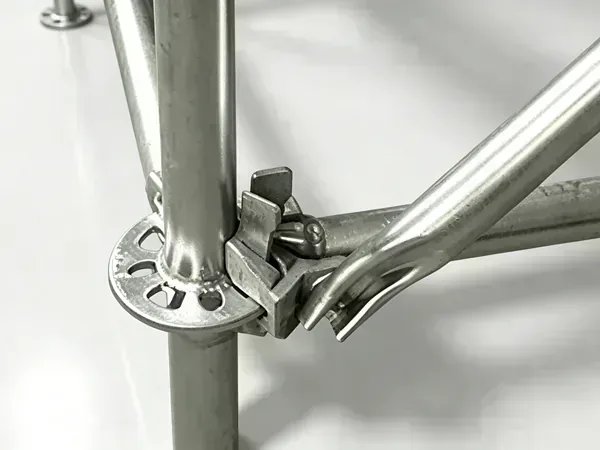
On the job, the diagonal brace runs corner-to-corner across a scaffold bay between two lifts of rosettes, turning the rectangular bay into a rigid triangle. Each brace head drops into the rosette's large holes — the ledgers use the four small holes — and the wedge is driven home with a hammer, so the brace holds the bay square and stops the lateral sway that would otherwise shift the load centre of gravity. Diagonal braces are rolled from Ø48.3×2.5 mm high-strength steel tube and sized to the bay they span — 0.65 to 3.05 m bay lengths on a standard 2.0 m rosette lift (1.5 m on request) — and they can double as guardrails and stair handrails. Like the rest of the system, the ringlock diagonal brace is hot-dip galvanized Q345/S355 steel, built to EN 12810 / EN 12811, ANSI and AS/NZS 1576, with ISO 9001 quality and FOB Shanghai delivery from ACE SCAFFOLD.
The brace triangulates the bay. Where a ledger sets the bay width and a standard sets the height, the diagonal brace locks the rectangle into a rigid triangle — the difference between a scaffold that sways and one that stays true.
Brace Head & Wedge Lock
Each end of a diagonal brace carries a cast-steel brace head with a captive wedge pin. The head hooks into the standard's rosette — braces use the four large holes, ledgers use the four small holes — and the wedge is hammered tight, locking the joint so it cannot work loose under vibration or wind.
Brace Sizing: Bay Length & Rise
A diagonal brace is specified by the bay it spans and the lift (rise) between rosettes. The standard rosette lift is 2.0 m (1.5 m optional), so the brace's working length is always longer than the bay it braces — a 2.13 m bay on a 2.0 m lift takes roughly a 2.9 m brace. Match the brace to the bay width and lift height for a true, rigid triangle.
Steel & Finish
Braces are rolled from high-strength steel tube (Ø48.3×2.5 mm) and hot-dip galvanized for long service in site, coastal and offshore conditions. Welds follow AWS D1.1 for clean, flat, seamless joints.
Packaging
Ringlock Scaffolding Diagonal Brace Specifications
| Description | MODEL | Unit Weight |
|---|---|---|
| Brace 2'2" / 0.65m | RSDB065 | 7.35 kgs |
| Brace 3'6" / 1.07m | RSDB107 | 8.40 kgs |
| Brace 5'2" / 1.57m | RSDB157 | 9.25 kgs |
| Brace 7' / 2.13m | RSDB213 | 10.31 kgs |
| Brace 8' / 2.44m | RSDB244 | 11.03 kgs |
| Brace 10' / 3.05m | RSDB305 | 12.15 kgs |
Frequently Asked Questions
What is a ringlock scaffolding diagonal brace?
Why does a ringlock scaffold need diagonal braces?
How does a diagonal brace connect to the standard?
What sizes do ringlock diagonal braces come in?
What material are ringlock diagonal braces made of?
Can ringlock diagonal braces be used as guardrails or handrails?
Related Products
- Ringlock Scaffolding
- Ringlock Scaffolding Standard
- Ringlock Caster Adapter
- Ringlock Base Collar
- Ringlock Scaffolding Ledger
- Ringlock Scaffolding Double Ledger
- Ringlock Scaffolding Crazy Leg
- Ringlock Scaffolding Leg Lock
- Ringlock Scaffolding Clamp Brace
- Ringlock Scaffolding Truss Ledger
- Ringlock Scaffolding Lattice Girder
- Ringlock Scaffolding Side Bracket
- Ringlock Scaffolding Console Bracket