
Prop Fork Head
Engineered to international standards for safety, speed and durability on every job site.
Overview
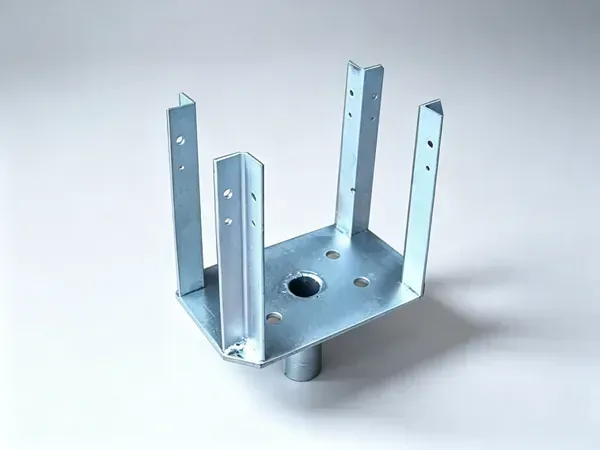
The Prop Fork Head is a fixed four-way cross head that fits on the top of a steel prop or scaffold standard to carry the beams of a concrete slab or beam formwork. A flat base plate, four angle irons and a spigot coupling make up the head: the spigot drops into the prop top plate, and the angle irons hold the H20 timber beam, steel beam or aluminium beam between them, with holes for nailing the head to the timber. Model TP02 weighs 2.6 kgs and is supplied galvanized or painted FOB Shanghai from ACE SCAFFOLD.
Key Features
- Four-way cross head for the top of a steel prop or standard
- Base plate, four angle irons and a spigot coupling
- Carries H20 timber beams, steel beams and aluminium beams
- Drilled angle irons let the head be nailed to a timber beam
- Fits steel props and ringlock, cuplock, kwikstage standards
- Q235 steel, 2.6 kgs, galvanized or painted, FOB Shanghai
A prop fork head is the beam support at the top of a shoring prop. Also called a cross head or four-way U head, it is built from a flat base plate, four angle irons and a spigot coupling that drops into the prop top plate or into the top of a scaffold standard. The four angle irons form an open fork that receives an H20 timber beam, a steel beam or an aluminium beam, and they are drilled so the head can be nailed to a timber beam to stop it lifting during the pour. Because the fork is open in four directions, beams can run through in either direction and cross at right angles over one prop. The TP02 model weighs 2.6 kgs and is supplied galvanized or painted. ACE SCAFFOLD supplies prop fork heads FOB Shanghai with OEM/ODM available.
What a Prop Fork Head Does
A prop fork head - also called a cross head or four-way U head - is the beam support that sits on the top of a steel prop or scaffold standard. It carries the primary and secondary beams of a concrete slab or beam formwork, so the load of the wet concrete passes down through the beams and into the prop.
Base Plate, Angle Irons and Spigot
The head is built from three parts: a flat base plate, four angle irons welded to it, and a spigot coupling below. The spigot drops into the prop top plate or into the top of a standard, and the four angle irons form the fork that receives the beam.
Holding H20 Timber Beams
The angle irons are drilled with holes so the head can be nailed to an H20 timber beam, which stops the beam from lifting or shifting during the pour. Because the fork is open in four directions, beams can run through the head in either direction and meet at right angles over a single prop.
Where a Prop Fork Head Is Used
Fit the fork head on adjustable steel props in slab and beam formwork, and on the standards of ringlock, cuplock, kwikstage and quick lock systems. It carries timber H20 beams, steel beams and aluminium beams, and it suits small-diameter tubular or striped spigots as well as the holes in a prop top plate.
Galvanized or Painted Finish
TP02 is supplied galvanized or painted for corrosion resistance on site. The finish protects the base plate, the angle irons and the spigot through repeated use, transport and outdoor storage.
Prop Fork Head Specifications
| NO. | Items | Surface | Weight |
|---|---|---|---|
| TP02 | Prop Fork Head | Galvanized/Painted | 2.6 kgs |