
Ringlock Scaffolding Truss Ledger
Engineered to international standards for safety, speed and durability on every job site.
Overview
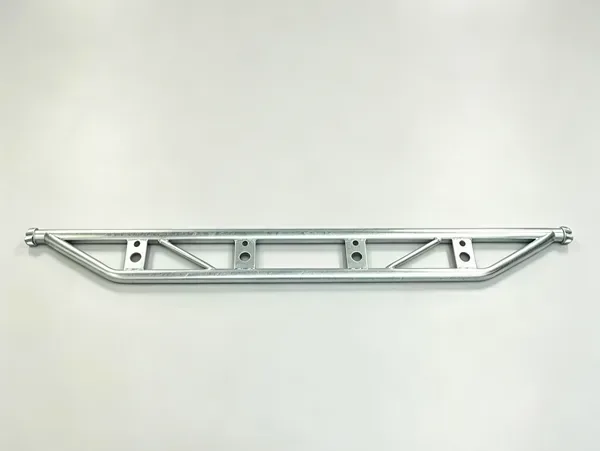
The Ringlock Scaffolding Truss Ledger — also known as a truss O-ledger — is a horizontal member built as a single reinforced ledger: one Ø48.3 working tube (where planks hook on) strengthened from below by a second chord and diagonal stiffener plates, not the two complete ledgers of a double ledger. That reinforced single deck roughly doubles the bending capacity of a standard ledger, so it carries heavy loads and spans wider bays without deflecting.
Key Features
- Twin-chord truss body — ~2× the bending capacity of a standard ledger
- Connects with the standard ringlock rosette wedge head
- Ø48.3×3.2 mm high-strength steel tube
- Lengths 6 ft to 10 ft (1.82–3.05 m)
- For heavy slab, hoists, shoring heads and long-span platforms
- Hot-dip galvanized Q345/S355, EN 12810 / AS-NZS 1576 / OSHA
Where a standard ringlock ledger is a single tube, a truss ledger is a single working tube reinforced from below by a second chord and diagonal stiffener plates, forming a rigid section that resists bending far better than one tube. (This is different from a double ledger, which pairs two complete ledgers side by side.) Truss ledgers are rolled from Ø48.3×3.2 mm high-strength steel tube and connect to the standard rosette with the same wedge-head ends as a standard ledger, so they drop straight into any ringlock bay. They are the right choice for heavy slab formwork, material hoists, shoring heads, façade grids and long-span working platforms where the imposed load exceeds a single ledger. Like the rest of the system, the ringlock truss ledger is hot-dip galvanized Q345/S355 steel, built to EN 12810 / EN 12811, ANSI, AS/NZS 1576 and OSHA, with ISO 9001 quality and FOB Shanghai delivery from ACE SCAFFOLD.
A truss ledger is a heavy-duty ledger. It looks like a standard ledger with the same rosette wedge ends, but the body is a reinforced single tube that carries roughly twice the load of a plain ledger at the same span.
Reinforced Single Tube
A truss ledger keeps ONE working Ø48.3 tube — the ledger that planks hook onto — and strengthens it from below with a second chord and diagonal stiffener plates. That lower chord adds bending stiffness but is not a second deck, so a truss ledger is still a single-level member.
Same Rosette Connection
Each end of a truss ledger carries the standard ringlock wedge head, so it locks into the rosette exactly like a normal ledger. No special fittings are needed, and it works with the same standards, planks and brackets as the rest of the system.
Truss Ledger vs Double Ledger
A truss ledger reinforces ONE ledger tube from below and keeps a single deck level. A double ledger, by contrast, pairs TWO complete ledgers into one rigid member — two working tubes, two deck lines. Choose a truss ledger when you need a single reinforced bay that stays flat under heavy load; choose a double ledger when the design calls for two ledger lines in one member (wide decks, cantilevers and heavy cladding).
Where to Use It
Truss ledgers are specified for heavy slab and formwork loads, material hoists, shoring heads, façade grids and long-span platforms where a single ledger would deflect or overload. They let engineers widen bay spacing without losing capacity.
Installation
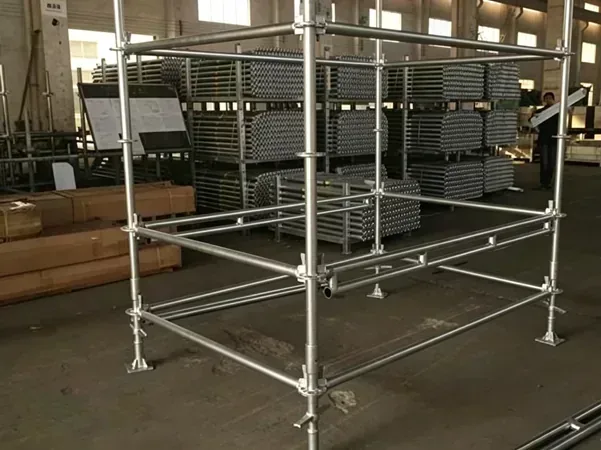
Ringlock Scaffolding Truss Ledger Specifications
| Description | MODEL | Unit Weight |
|---|---|---|
| Truss Ledger O-Type 1.82m / 6' | RSTL182 | 12.38 kgs |
| Truss Ledger O-Type 2.13m / 7' | RSTL213 | 14.1 kgs |
| Truss Ledger O-Type 2.43m / 8' | RSTL243 | 16.35 kgs |
| Truss Ledger O-Type 3.05m / 10' | RSTL305 | 20.38 kgs |
Frequently Asked Questions
What is a ringlock scaffolding truss ledger?
How is a truss ledger different from a standard ringlock ledger?
How does a truss ledger connect to the standard?
What is a truss ledger used for?
What sizes and materials do truss ledgers come in?
Can truss ledgers be combined with standard ledgers on the same bay?
Related Products
- Ringlock Scaffolding
- Ringlock Scaffolding Standard
- Ringlock Caster Adapter
- Ringlock Base Collar
- Ringlock Scaffolding Ledger
- Ringlock Scaffolding Double Ledger
- Ringlock Scaffolding Crazy Leg
- Ringlock Scaffolding Leg Lock
- Ringlock Scaffolding Diagonal Brace
- Ringlock Scaffolding Clamp Brace
- Ringlock Scaffolding Lattice Girder
- Ringlock Scaffolding Side Bracket
- Ringlock Scaffolding Console Bracket